

 " alt="">
Aged Care
What’s Included in Luxury Aged Care Fees (And What’s Not)
When families start comparing luxury aged care homes, the question that comes up fastest is also the hardest one to get a straight answer to: what am I actually paying for? Glossy brochures show the cinema, the café and the landscaped gardens, but rarely explain which of those sit inside your fees and which arrive as a separate line item later.
Here is the part most families are surprised by. In Australia, the fee structure for residential aged care is set by government and is the same whether a home is basic or beautifully appointed. What changes between providers is not the framework. It is what each home chooses to include as standard, and what it charges extra for. Understanding that distinction is the key to comparing homes honestly.
Below is a plain-English breakdown of what’s included in luxury aged care fees, what sits outside them, and the questions worth asking before you sign anything.
How Residential Aged Care Fees Are Structured
Since the new Aged Care Act arrangements commenced on 1 November 2025, residential aged care fees have four possible components. Not everyone pays all four.
- Basic daily fee: everyone pays this. It is pegged at 85% of the single Age Pension, which put it at $66.80 a day as at March 2026. It is indexed every March and September.
- Hotelling contribution: up to $22.15 a day, for residents with the means to contribute toward everyday living costs like catering, cleaning and laundry.
- Non-clinical care contribution: up to $107.32 a day, based on your income and assets. This one has real protections attached: it stops after four years, or once you reach a lifetime cap of $137,910.01, whichever comes first.
- Accommodation payment: what you pay for your room, either as a refundable lump sum (RAD), a daily payment (DAP), or a combination of both.
Your income and assets determine which of these apply to you and at what rate. Services Australia works that out through a means assessment, and the outcome often surprises people in both directions. We have covered that process in detail in our guide to what you’ll be asked in a means assessment.
Rates are indexed twice a year, so always confirm current figures against My Aged Care’s costs and fees page before budgeting.
Luxury Aged Care Fees: What’s Included as Standard
Clinical care is the constant. Every accredited home in Australia must provide the same standard of care, funded the same way, and is held to the same Aged Care Quality Standards. A premium home does not buy you a different category of nursing. It buys you the environment that care is delivered in.
Across a well-appointed community, your fees should already cover:
- 24-hour nursing and personal care: registered nurses, enrolled nurses and personal carers on site around the clock, plus coordination of visiting GPs, dentists, audiologists and allied health professionals.
- All meals, prepared fresh on site: at Palm Lake Care, chefs cook daily, with dietary needs accommodated and the option to dine privately or in your suite.
- Your suite: a private room with ensuite, individual air-conditioning control, free wifi and a direct dial phone line.
- Laundry, cleaning and maintenance: including valet laundry service.
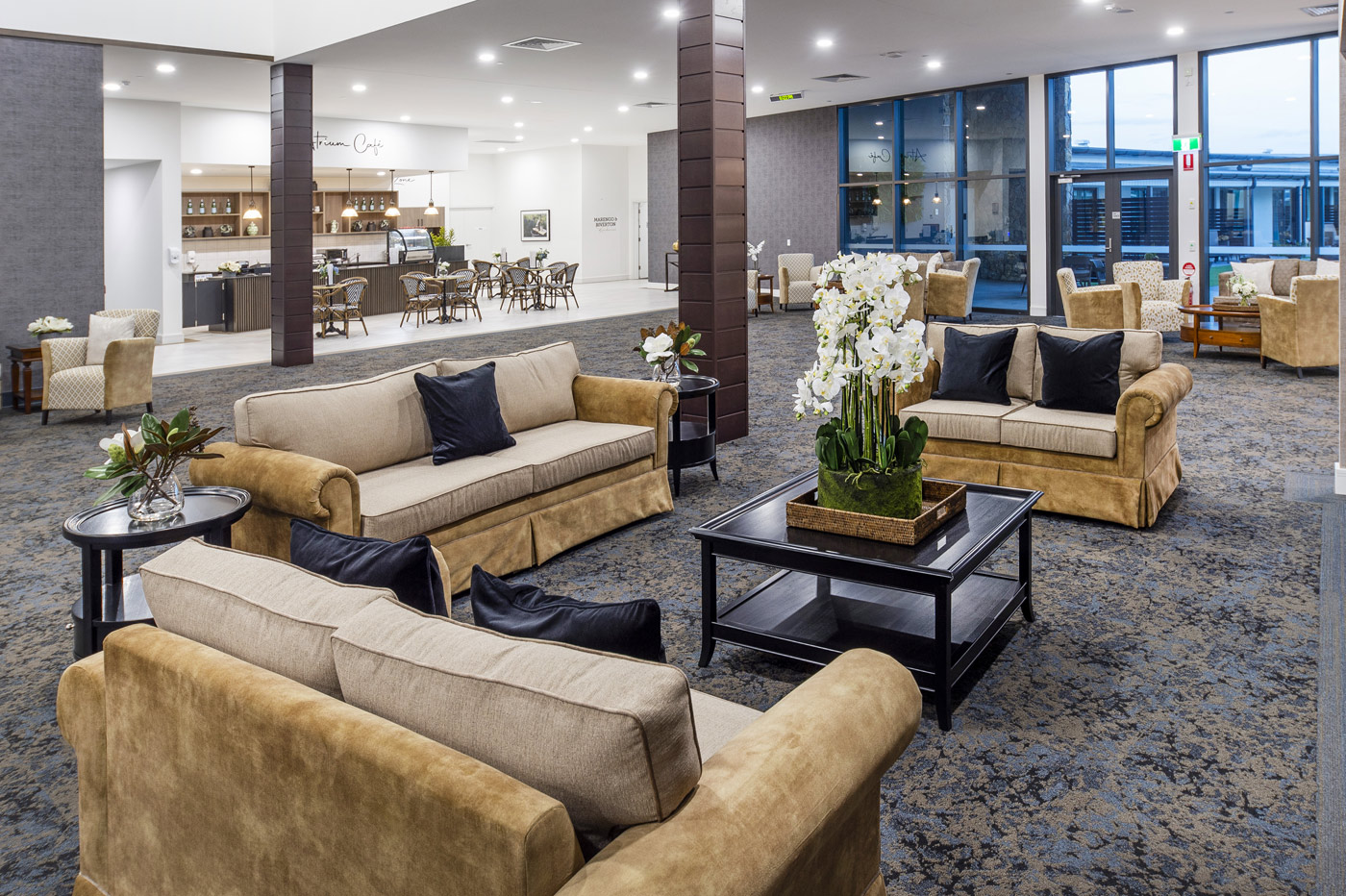
- Lifestyle and recreation: this is where a premium community genuinely differs. A movie theatre, billiards room, outdoor bowls green, grand piano, café, onsite salon and furnished outdoor spaces are part of the community, not a paid add-on.
- Specialist care where it is needed: memory support and palliative care at selected communities, delivered as part of your care plan.
The important thing to test on a tour is whether those lifestyle spaces are included or metered. A cinema you pay per session to use is a very different proposition to one that is simply part of where you live. You can see how this works across our communities on the Our Care page.
What’s Not Included in Your Fees
Three categories sit outside the standard fees, and the third is the one families most often miss.
1. Personal expenses
Your fees do not cover pharmacy and prescriptions, hairdressing and beauty treatments, private outings and transport, newspapers and magazines, personal toiletries, private health insurance, or a personal mobile phone plan. None of this is unusual, but it adds up, and it is worth building a modest monthly allowance into your planning.
2. Higher Everyday Living Fees
A Higher Everyday Living Fee (HELF) is an optional charge for services that go beyond what a provider is required to deliver. Think premium wine with dinner, in-room streaming subscriptions or a higher-specification room finish. HELF replaced the old extra service and additional service fees from 1 November 2025, and the rules around it are strict. Providers cannot charge a HELF for accommodation, for required care, for ordinary running costs, or for building maintenance and refurbishment. Agreements must be in writing, cannot be signed before entry, carry a 28-day cooling-off period, and can only rise in line with CPI.
A HELF is always optional, and choosing not to pay one must never affect the care you receive. The Department of Health, Disability and Ageing sets out exactly what can and cannot be charged.
3. The retention amount on your deposit
This is the change most families have not caught up with. If you pay a refundable accommodation deposit and entered care for the first time after 31 October 2025, your provider can now retain 2% of the deposit balance per year, for up to five years. On a $550,000 RAD, that is a meaningful sum that is not refunded when you leave. It is legislated, it applies across the sector, and it should be factored into any comparison between paying a lump sum and paying daily. The retention rules are published in full by the Department.
Does “Luxury” Actually Mean Higher Fees?
Not in the way most people assume. The basic daily fee, hotelling contribution and non-clinical care contribution are capped by government and calculated from your own means. They do not increase because a home has a better café.
Where premium homes genuinely cost more is the accommodation payment, because that reflects the room, the building and the location. A larger suite with a garden outlook in a well-maintained community will carry a higher RAD or DAP than a shared room elsewhere. That price must be published and agreed before you move in, so it is knowable and comparable from the outset.
So the honest answer is that luxury shows up in one line of your fees, not all four. And a home that includes its amenities as standard can work out better value than a cheaper home that charges a HELF for the same things. Compare the total, not the headline. Our Get Started page walks through how the funding side works.
Questions Worth Asking Before You Sign
- What is the published accommodation price for this specific room, and what is the RAD, DAP and combination equivalent?
- Is there a Higher Everyday Living Fee here? If so, exactly what does it include, and what happens if I decline it?
- Which lifestyle facilities are included, and are any charged per use?
- What will I be billed for separately each month?
- How much of my deposit will be retained, and over what period?
Get the answers in writing. A provider confident in its pricing will have no difficulty putting it on paper.
Frequently Asked Questions
Do I have to pay a Higher Everyday Living Fee?
No. A HELF is entirely optional and requires a separate written agreement signed after you enter care. Declining it cannot affect the standard of care you receive, and you have 28 days to change your mind after signing.
Is the basic daily fee the same at every aged care home?
Yes. It is set at 85% of the single Age Pension nationally and indexed each March and September, so it does not vary between a basic home and a premium one.
What happens if I cannot afford aged care fees?
Government subsidies cover the bulk of care costs for most residents, and financial hardship assistance is available for people who genuinely cannot meet their contributions. Your means assessment determines what you pay, and low-means residents may have accommodation costs fully or partly covered.
Will my fees go up after I move in?
The government-set components are indexed twice yearly in line with the Age Pension. Your non-clinical care contribution is reviewed quarterly as your circumstances change. A HELF can only increase in line with CPI, and your accommodation price is locked at the rate agreed when you entered.
Do I get my accommodation deposit back?
Yes, minus any agreed deductions and the retention amount described above. For residents who entered after 31 October 2025, that retention is 2% of the balance per year for a maximum of five years. The remainder is refunded, and is government-guaranteed.
Where to Go From Here
Aged care pricing is more transparent than it looks once you separate the four government components from the optional extras. The homes worth your time are the ones that will sit down and walk you through every line before you commit.
Palm Lake Care has communities at Bargara, Beachmere, Bethania, Caloundra, Deception Bay, Mt Warren Park and Toowoomba, each with a dedicated Customer Experience team member who handles your enquiry from the first phone call through to moving day. They can prepare a written fee estimate for the specific suite you are considering.
We would also encourage you to speak with an accredited aged care financial adviser before making a decision on RAD versus DAP. It is a genuinely consequential choice, and independent advice is worth the fee.
Enquire now to arrange a tour and a no-obligation fee estimate at your nearest Palm Lake Care community.
Fee figures cited are current as at March 2026 and are indexed each March and September. Confirm current rates with the Department of Health, Disability and Ageing or your provider. This article is general information only and is not financial advice.